How to Choose a Fire Restoration Company in Boulder County
Vetting a Boulder fire restoration company? What IICRC FSRT means, specialist vs generalist, questions to ask, and red flags to avoid.
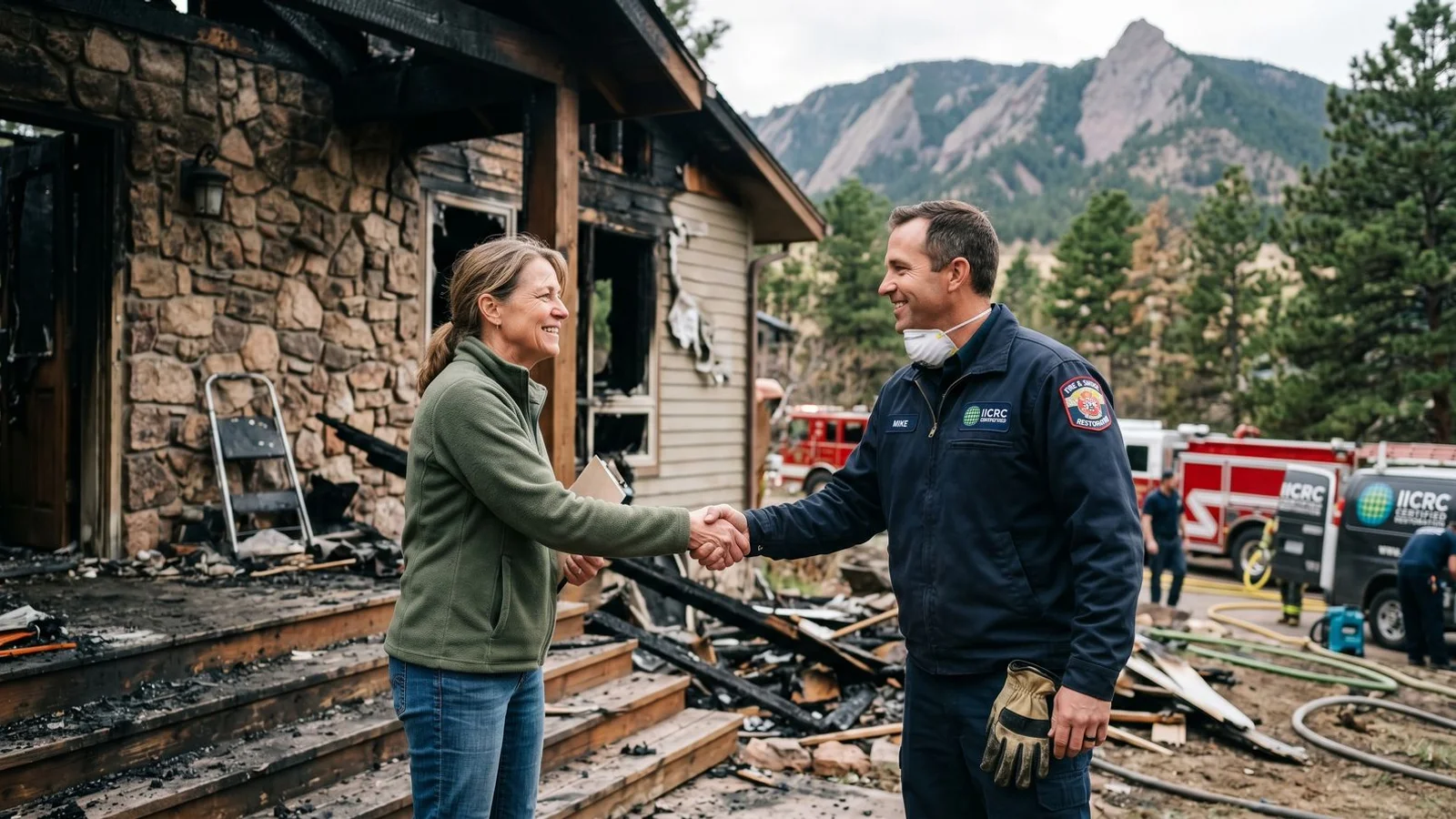
We know that seeing your home damaged by fire is overwhelming. That first call with your insurance carrier often feels like a lifeline, especially when the adjuster offers to send out a preferred team right away. Most people accept this help without a second thought.
This is a critical mistake.
Choosing a fire restoration company in Boulder requires looking past the easy option. You want an advocate who works for you, not just someone trying to close out a claim cheaply. Let us look at the data behind insurance recommendations and outline exactly how to vet a fire restoration contractor.
When the insurer’s “recommended” vendor calls, slow down
You should immediately pause the process when your carrier offers to send their preferred vendor to your property. These contractors operate under strict volume agreements with the insurance company. This dynamic often means they must accept lower profit margins and limited repair scopes.
“Colorado Law C.R.S. 10-4-120 protects the right of the individual to choose a repair business. An insurance company cannot directly or indirectly require that repairs be made by a specified repair business.”
Our team has personally seen how financial arrangements prioritize the carrier’s bottom line over the full restoration of your home. The insurance company controls the flow of work, so the preferred vendor is highly motivated to keep claim costs down. They typically achieve this by using generic materials or rushing the cleaning process.
You are completely free to hire an independent specialist with deeper local expertise. A dedicated professional will document the damage accurately and ensure your property meets all current Boulder County building codes.
Six questions every fire restoration company should answer
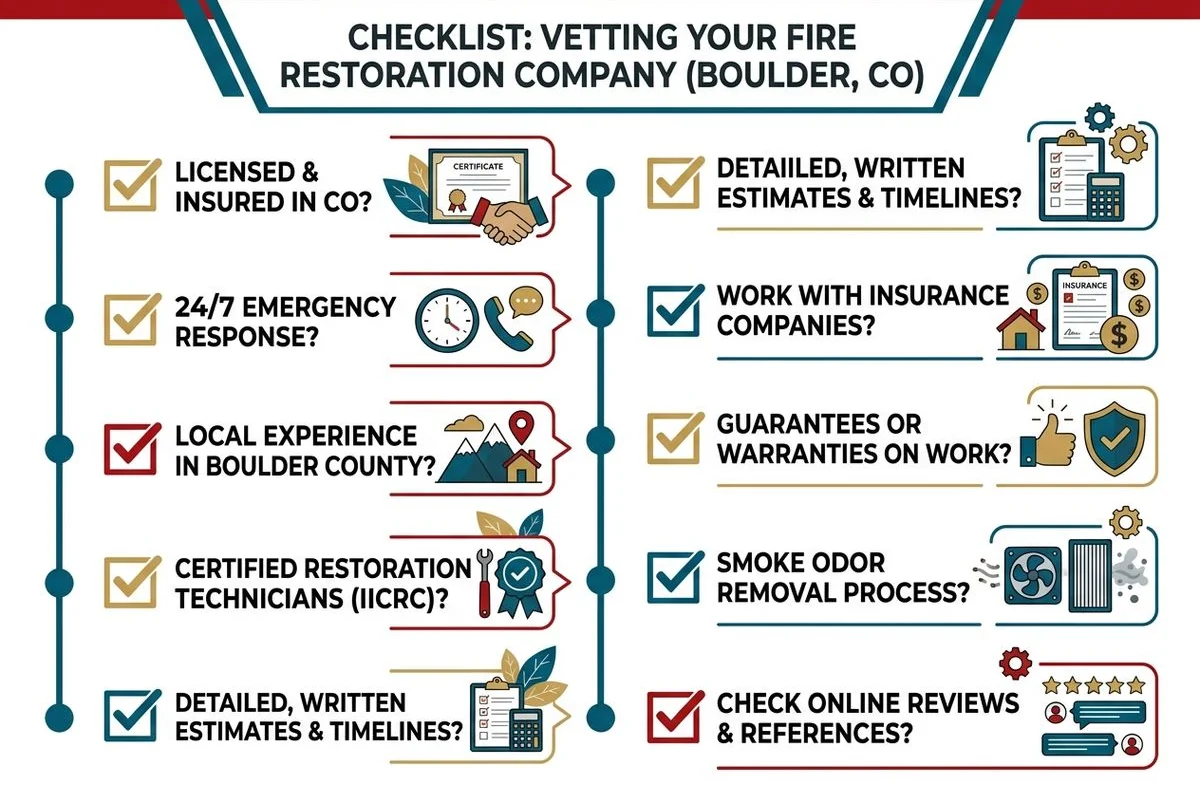
You must ask specific, technical questions during the interview to separate true experts from general handymen. Use the following checklist to evaluate every potential contractor before signing any agreements. We always recommend starting with certification checks to find the best fire restoration company Boulder has available.
- Are your technicians IICRC FSRT certified? This credential requires a 16-hour course and a proctored exam. Ask them specifically about the ANSI/IICRC S700 standard, which is the current framework for handling fire and smoke damage.
- Do you specialize in fire damage? Specialists understand the crucial difference between Category I dry soot and Category III protein residues. Generalists often try to treat all smoke damage with the exact same chemical process.
- Do you bill directly using Xactimate? Over 75% of insurance adjusters use Xactimate software to calculate costs. Your contractor must use this exact same system to prevent massive pricing disputes.
- Is reconstruction handled in-house? Managing both the cleanup and the rebuild prevents costly delays. This detail is crucial if you are trying to meet the December 31, 2026 deadline for Xcel Energy rebuilding rebates in Boulder County.
- What exactly does your smoke odor guarantee cover? A valid guarantee promises free re-treatment if the odor returns within a specific timeframe. Vague promises are completely useless.
- Can I see local Boulder County references from the past year? Recent references prove they understand local permit timelines and Wildfire Zone 1 mitigation requirements.
Direct billing with the right software removes the cash flow burden from your shoulders. The contractor submits detailed line items directly to the carrier. This process requires precise documentation to secure full funding.
Our estimators spend hours aligning every single detail with the adjuster’s pricing data. If a contractor just hands you a lump-sum invoice, the insurance company will likely reject it. You will then be stuck paying the difference out of your own pocket.
Red flags that should end the conversation
You should walk away immediately if a contractor refuses to provide verifiable licensing or pressures you into signing vague documents. A professional firm will always operate with complete transparency. We look out for specific warning signs that indicate a company might cut corners.
- Missing insurance and licensing. Always verify their Colorado contractor license and ask for a Certificate of Insurance (COI) before allowing anyone on your property.
- Aggressive Assignment of Benefits (AOB) contracts. An AOB transfers your claim rights to the contractor. Read these documents closely so you do not lose control of your insurance settlement.
- Lowball estimates. A quote that comes in 40% lower than others usually omits critical Category III cleaning line items in Xactimate. This tactic inevitably leads to expensive change orders later.
- No clear timeline. A professional provides milestones and deadlines. Vague statements do not constitute a real project plan.
- Storm-chaser tactics. Out-of-state crews often flood the area after regional events like the Marshall Fire. They rarely stick around to honor their warranties.
| Warning Sign | What It Means | The Better Alternative |
|---|---|---|
| Hand-written lump sum quote | The insurance adjuster will likely deny the claim format. | Detailed Xactimate line-item estimate. |
| Out-of-state license plates | They may leave before completing warranty work. | Established local Boulder County business. |
| Pressures you to use their adjuster | They want full control over the payout amounts. | Encourages independent appraisal if needed. |
What IICRC FSRT actually involves
The Fire and Smoke Restoration Technician (FSRT) credential proves that a worker understands complex soot chemistry and structural cleaning techniques. It separates trained professionals from basic cleaning crews.
While older documentation referenced the S500 standard, the industry now relies heavily on the updated ANSI/IICRC S700 standard specifically for fire and smoke.
Our team undergoes rigorous continuing education to maintain these credentials. Technicians must understand how electrical fires create dry residues that travel deep into HVAC systems. They also learn how kitchen fires produce wet, sticky protein residues that require specialized emulsifying agents.
A certified firm also knows when to call in specialized help. Rebuilding older structures in Boulder often triggers EPA NESHAP requirements for asbestos and lead testing. A trained FSRT professional spots these environmental hazards before any demolition begins.
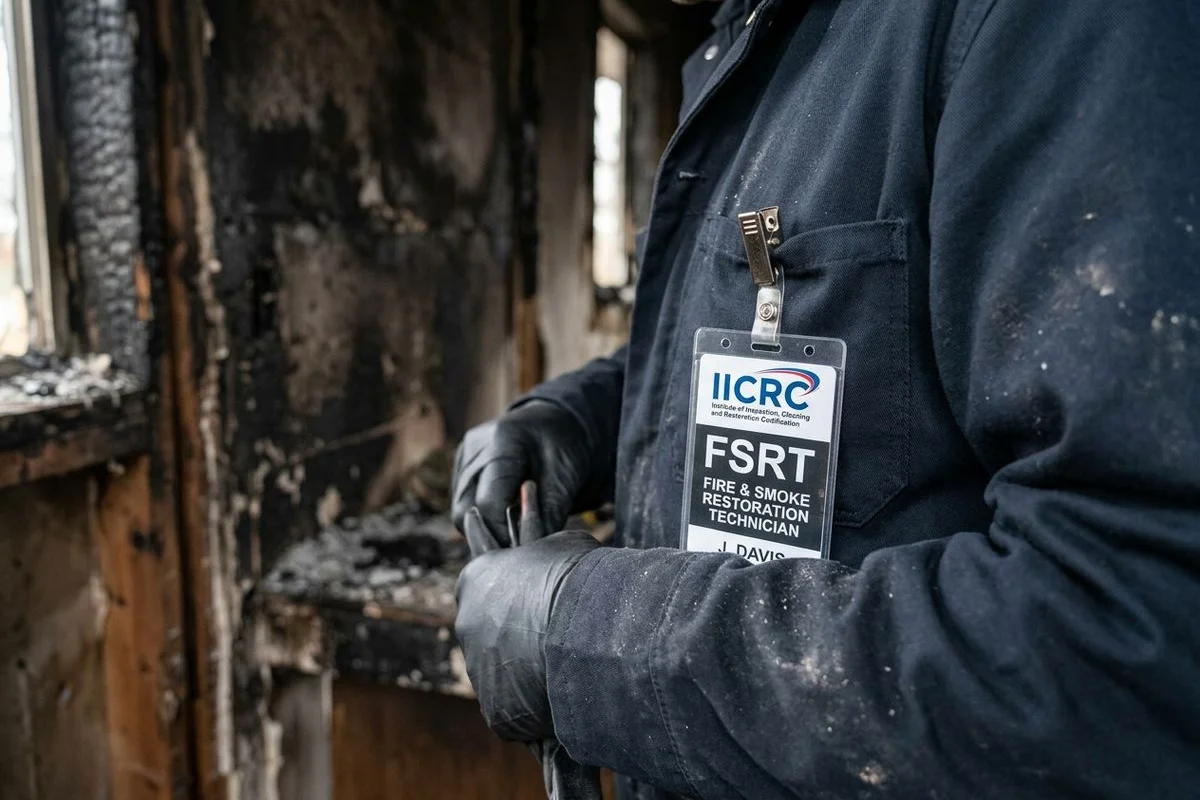
We are an IICRC-certified firm with FSRT and OCT (Odor Control Technician) certifications on our crew. The state of Colorado verifies our current contractor license, and we maintain an A+ accreditation with the BBB. This strong foundation includes EPA Lead-Safe certification to ensure your property is handled legally and safely.
A fast read on whether a contractor is right for you
You can accurately evaluate a contractor by reviewing their final proposal in detail for at least 30 minutes. A comprehensive document shows they respect the process and value your property. A strong proposal must include specific elements to protect your investment.
- Granular scope of work. Every action needs a specific line item rather than a broad lump sum.
- Xactimate alignment. The pricing must match the database used by your insurance adjuster.
- Defined schedule. Look for clear start dates and completion milestones.
- Communication protocols. Identify who your project manager is and how often they will contact you.
- Written warranties. Odor removal guarantees must be clearly documented.
- Attached credentials. Copies of the COI and state license should be included by default.
Our project managers are happy to walk you through every page of an estimate. If another contractor gets defensive when you ask for these details, you have your answer. A legitimate business has nothing to hide.
For more on insurance and your rights, see our fire damage insurance claims page. To talk through your specific situation with one of our specialists, reach our 24/7 dispatch line. By carefully choosing a fire restoration company in Boulder, you ensure your home is fully restored.
Frequently asked questions
What does IICRC FSRT mean? +
IICRC stands for the Institute of Inspection, Cleaning and Restoration Certification — the industry credentialing body. FSRT is the Fire & Smoke Restoration Technician certification. An FSRT-certified technician has been trained and tested on the protocols proven to work for fire and smoke. It's the basic credential to look for.
Do I have to use my insurer's preferred vendor? +
No. Colorado Law CO 10-4-120 protects your right to choose any qualified restoration contractor — including a fire specialist instead of the insurer's preferred general restoration vendor. Asserting that right is straightforward: tell your insurer in writing which contractor you've selected.
Is a fire specialist better than a general restoration company? +
Almost always, yes — for fires. General restoration companies handle water, mold, fire, biohazard, and storm work, which means they're stretched across multiple disciplines. A fire specialist has deeper protocols, better equipment for smoke odor specifically, and more experience with insurance scoping.
Need help with fire or smoke damage in Boulder?
24/7 emergency response with a 60-minute guarantee across Boulder County. Call our team — we'll secure your property and walk you through the next steps.