Preventing Mold After a Fire in Boulder County
Mold can start within 48 hours after firefighting water. The mold-growth window, humidity control, antimicrobial treatment, and Colorado climate factors.
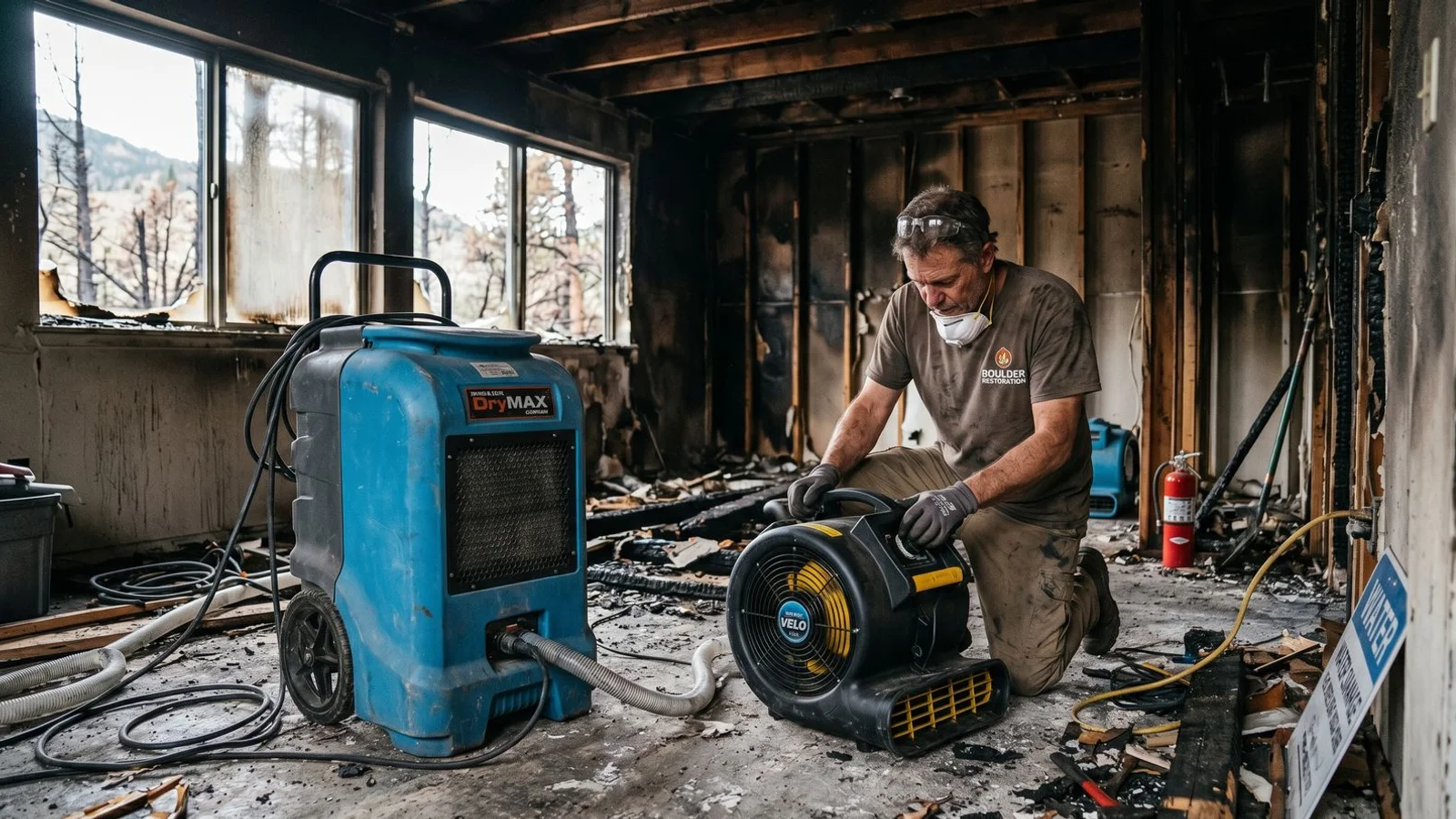
Mold is the silent compounder of fire damage
You must stop mold growth fire damage immediately because remediation can add up to $17 per square foot to your final repair bill. We see homeowners breathe a huge sigh of relief once the fire trucks leave, only to panic eight weeks later. A musty smell often takes over a room far from the actual burn area.
Mold testing frequently finds active colonies in hidden spaces.
- Inside dark wall cavities
- Tucked behind kitchen cabinets
- Spreading across basement subfloors
- Trapped under thick carpet padding
Our experts know you can easily prevent mold after fire with rapid firefighting water extraction in the first 48 hours.
A fast response is the only way to avoid these hidden expenses. Let us explore the timeline of water damage and how professional extraction protects your home.
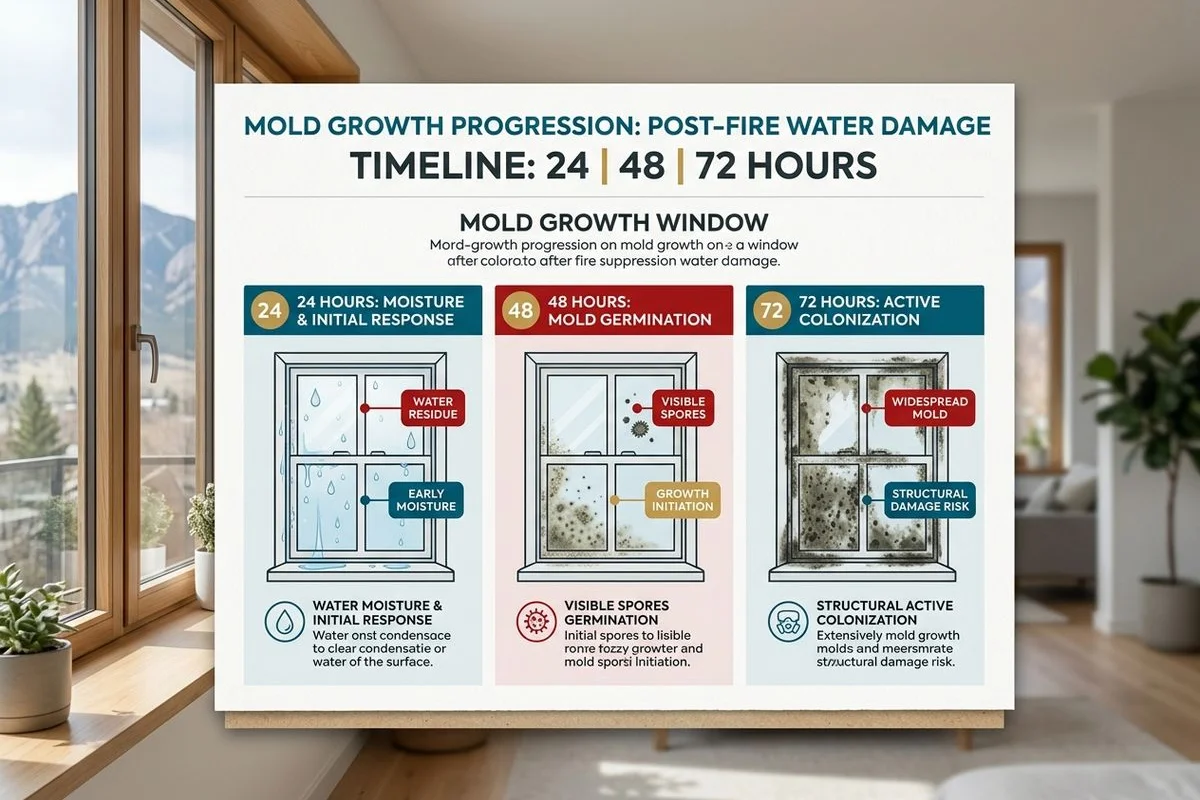
The mold window: 24 to 48 hours
Fungal spores begin colonizing wet drywall within 24 to 48 hours after the flames are extinguished. We recommend dropping indoor relative humidity below 60% immediately to freeze this biological clock.
Mold spores exist everywhere in your home before the fire and in every breath of air. They remain completely harmless until they encounter the perfect combination of moisture, warmth, and food.
After a structural fire suppression, your house has all three elements in abundance.
- Moisture: Firefighters leave behind thousands of gallons of hose water.
- Warmth: Indoor heating easily pushes temperatures into the 70 to 90 degree Fahrenheit range.
- Food: Paper-faced drywall, cellulose insulation, and wood framing provide an endless buffet.
Our technicians frequently encounter specific opportunistic fungi after a blaze. Aspergillus is extremely common because it thrives on damp building materials. This particular strain can appear white or yellow, making it very hard to spot against wet drywall.
Toxic black mold, scientifically known as Stachybotrys, also rapidly consumes wet cellulose materials.
By 24 hours, these microscopic colonies can start forming roots. Growth is firmly established by the 48-hour mark. You will absolutely pay for expensive remediation if wet conditions persist for 72 hours.
Stopping the clock with fast extraction
The single most important action for mold prevention after firefighting is rapid water extraction within hours of the incident. We dispatch crews within 60 minutes of your call to get standing water out on the very same day.
The moisture window closes much faster than the mold window opens. Industry standards from the Institute of Inspection, Cleaning and Restoration Certification dictate a rapid response to standing water.
Our team sets up commercial Low Grain Refrigerant dehumidifiers within hours to pull moisture from the air. This aggressive approach drastically changes the recovery timeline.
The Extraction Timeline
The math behind water removal is incredibly straightforward.
- Within 12 hours: Immediate extraction typically prevents fungal problems completely.
- At 36 hours: Removing water at this stage significantly reduces secondary damage.
- At 60 hours: Waiting this long almost guarantees the remediation scope will expand.
You must get ahead of the water before it saturates the structural framing.
Humidity control across the structure
Controlling ambient humidity is just as critical as extracting standing pools of water. We utilize commercial-grade air movers to accelerate evaporation from wet surfaces across the entire structure.
These machines lower the relative humidity below 50% in hidden cavities and deep basement spaces. The combination of air movement and mechanical dehumidification dries most homes within three to seven days.
Achieving the Strict Dry-Standard
Our goal is to hit the exact moisture targets established by the International Residential Code. Wood framing must drop below a 16% moisture content before contractors can safely close up the walls.
Residential dehumidifiers simply cannot move the required volume of air to hit this target. They lack the specialized technology needed for structural drying.
| Feature | Commercial LGR Dehumidifier | Standard Residential Unit |
|---|---|---|
| Water Removal Rate | 130+ Pints Per Day | 30 to 50 Pints Per Day |
| Airflow Capacity | Over 300 CFM | Under 150 CFM |
| Target Moisture Level | Pulls moisture from deep materials | Only handles surface humidity |
Our equipment forces moisture out of the deep reservoirs inside your home. This aggressive drying strategy prevents secondary structural decay.
Antimicrobial treatment when warranted
Antimicrobial treatments are applied directly to wet framing and drywall when saturated conditions exceed 48 hours. We use these specialized chemical agents to suppress any colonies that may have started growing in the early hours.
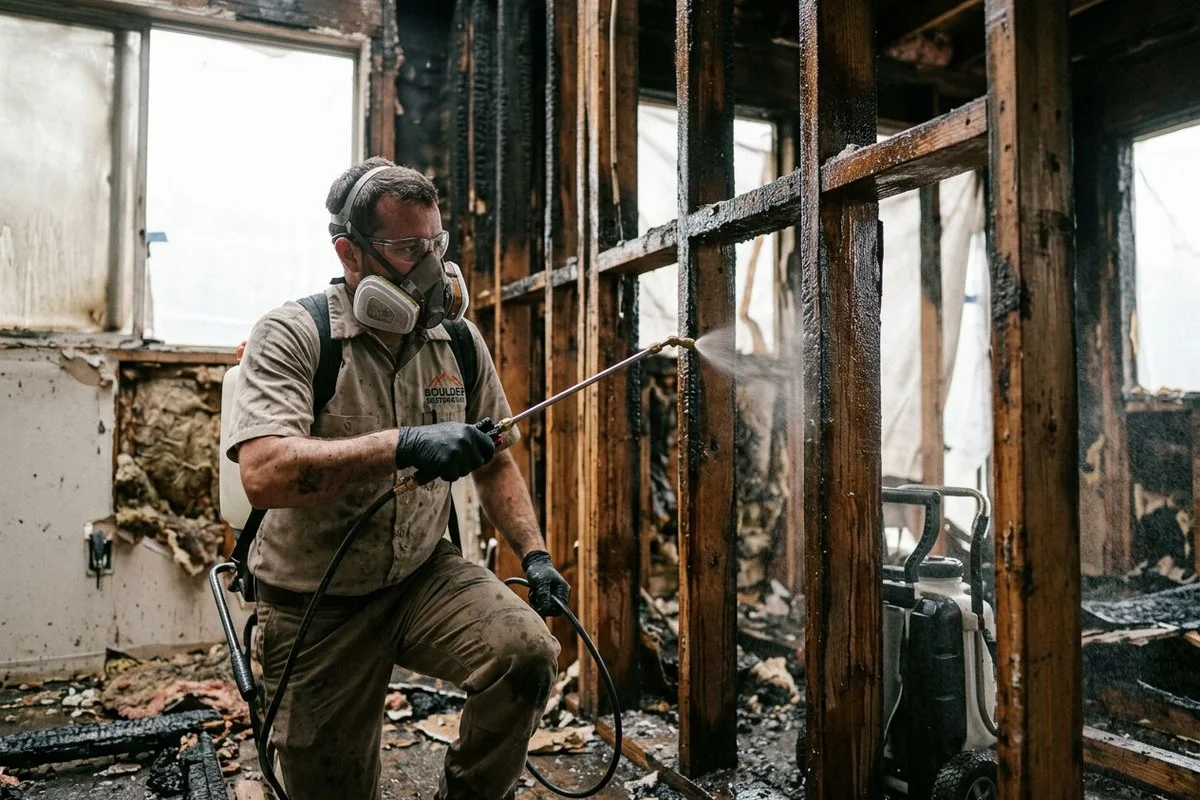
These products prevent spores from establishing a foothold during the remaining dry-out period.
Our specialists rely on commercial treatments containing safe, active ingredients like hydrogen peroxide or quaternary ammonium compounds. You should never just spray household bleach on porous wood because it only bleaches the surface layer.
Professional antimicrobials penetrate the cellular structure of the wood to neutralize the threat at its root.
When to Apply Chemical Treatments
Treatment is not always required for every single water incident.
- When extraction is delayed beyond two days
- If Category 3 contaminated water is present
- When dealing with high-risk individuals in the home
- If visible discoloration has already begun
We apply these solutions methodically to ensure maximum coverage and protection.
The Colorado climate misconception
Opening your windows in Boulder County will not dry out the hidden moisture trapped inside your walls. We constantly see homeowners make the mistake of assuming our dry local climate is a substitute for active mechanical dry-out.
The outdoor relative humidity in Colorado is genuinely helpful during the summer months. This low ambient moisture makes our commercial dehumidification equipment run much more efficiently.
Our crews know that outdoor air simply cannot reach the water trapped in a structural envelope.
- Behind layered drywall
- Deep inside wall cavities
- Soaked into thick carpet padding
- Trapped against the subfloor
Active dehumidification with heavy air movement is the only way to pull moisture out of these tight reservoirs. The concept of vapor pressure dictates that water needs a strong mechanical push to evaporate from confined spaces. You cannot rely on a gentle mountain breeze to save your drywall.
Documentation that proves the prevention worked
Taking daily moisture readings during the dry-out phase provides the critical evidence base that proves your materials reached the dry standard. We document every step to show that the walls were completely safe before reconstruction began.
This thorough record-keeping is not just a meaningless compliance exercise. It actively protects you from future liability.
Tools for Verifying the Dry-Standard
Our project managers use specialized equipment to map the exact water boundaries inside your home.
- Penetrating moisture meters: Measure water content deep inside wood framing.
- FLIR thermal imaging cameras: Detect hidden temperature changes caused by trapped water.
- Hygrometers: Track the ambient relative humidity in isolated microclimates.
These advanced tools verify that every inch of structural framing sits well below the safe 16% moisture threshold.
Any fungal issue discovered six months later is officially documented as a separate, post-restoration event rather than a failed initial dry-out. Insurance companies demand this rigorous documentation to process claims smoothly.
You can learn more about our exact methodology by reviewing the structural dry-out process after firefighting used by top professionals. Understanding the complete picture of why fire causes water and mold damage is the best way to protect your property moving forward. Take action today and call a certified restoration team to secure your home.
Frequently asked questions
How soon can mold grow after a fire? +
Often within 24-48 hours of water exposure. Mold spores are present everywhere; given moisture, warmth, and an organic substrate, colonies can begin almost immediately.
How do you prevent mold during dry-out? +
Rapid water extraction, commercial-grade dehumidification, ANSI/IICRC S500-aligned monitoring, and antimicrobial treatment of any materials wet past 48 hours. The earlier extraction starts, the lower the mold risk.
Does Colorado's dry climate prevent mold? +
Outdoor relative humidity helps, but it doesn't reach the moisture trapped inside saturated walls, framing, and carpet pad. Indoor mold growth is driven by indoor moisture conditions, not outdoor climate. Don't rely on the dry climate to do dry-out's work.
Need help with fire or smoke damage in Boulder?
24/7 emergency response with a 60-minute guarantee across Boulder County. Call our team — we'll secure your property and walk you through the next steps.