Grease Fire and Protein Soot Damage Explained
Kitchen fires leave protein soot — a nearly invisible greasy film with intense odor that ordinary cleaning misses. Why it needs specialized removal.
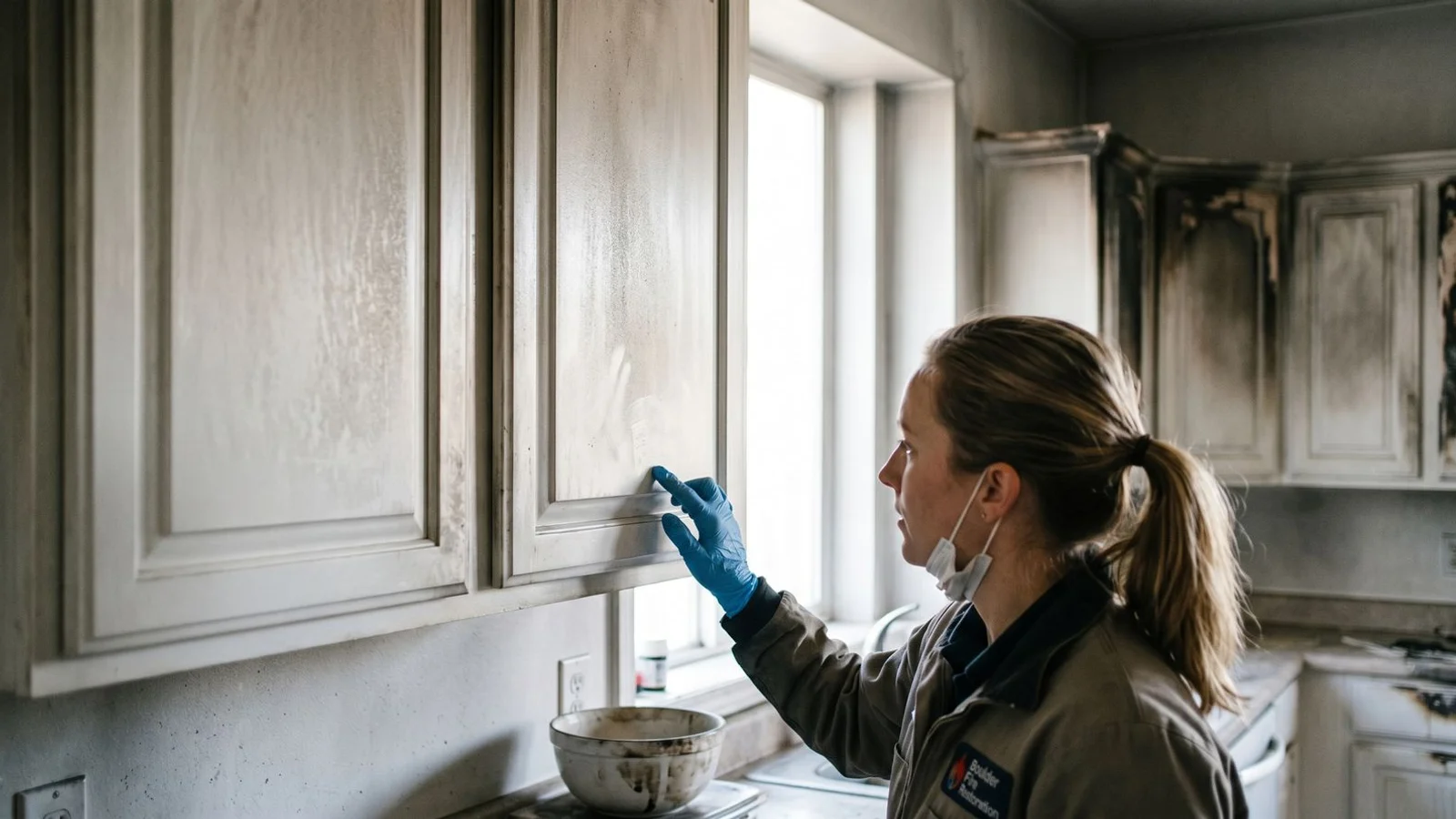
Most people assume the worst part of a protein soot kitchen fire is the visible scorch marks.
We see it differently after two decades of restoring homes along the Colorado Front Range.
That melted range hood is actually the easy part to fix.
The real nightmare is what you cannot see right away.
Our technicians call it protein soot, and it is a thin, invisible film that spreads everywhere the smoke traveled.
According to the National Fire Protection Association in 2025, cooking causes roughly 49 percent of all reported home fires in the US.
We find that nearly all of these incidents leave behind an overwhelming, pungent odor of burnt food that simply refuses to fade.
Let’s look at the science behind this sticky residue, why standard cleaning sprays fail, and the exact steps required to neutralize the smell permanently.
What is protein soot?
Cooking oils and fatty meats ignite at temperatures around 600 degrees Fahrenheit.
We find that this extreme heat causes the amino acids to vaporize instantly into the smoke.
These microscopic vapor droplets travel far past the stove.
As the smoke cools, those vaporized proteins condense onto every available cool surface.
Our crews frequently find this residue coating walls, ceilings, cabinet interiors, and even surfaces three rooms away.
This specific byproduct behaves completely differently than the dry, powdery black ash from a wood or paper fire.
The residue is:
- Thin: A tight film applies to the surface, rather than a loose powder.
- Greasy: The surface feels oily to the touch, but looks visually subtle.
- Translucent: You cannot see the layer against most surfaces under standard room lighting.
- Pungent: The intense burned-protein smell triggers strong physical reactions.
- Sticky: The chemical bond adheres tightly and resists standard water-based wiping.
You will often only spot this glaze by shining a flashlight parallel to the surface, known as raking light.
Our inspectors rely on this technique to find the slight sheen or unevenness that catches the eye.
Why ordinary cleaning fails or makes it worse
The Problem with Water-Based Chemistry
The immediate instinct after a kitchen flare-up is to grab paper towels and a standard household cleaner.
We constantly see this fail because treating an oil-based grease fire residue with a water-based product typically creates a much larger mess.
Standard dish soaps and multi-surface sprays simply lack the pH levels required to break down complex resins.
Our experience shows that applying these household chemicals usually just smears the contamination over a wider area.
This approach usually fails for three specific reasons:
- You clean blind: Without specialized raking light, you have no idea if you actually removed the film or just pushed it around.
- Water smears grease: Protein soot is inherently oily, so water-based chemistry just spreads the contaminants wider.
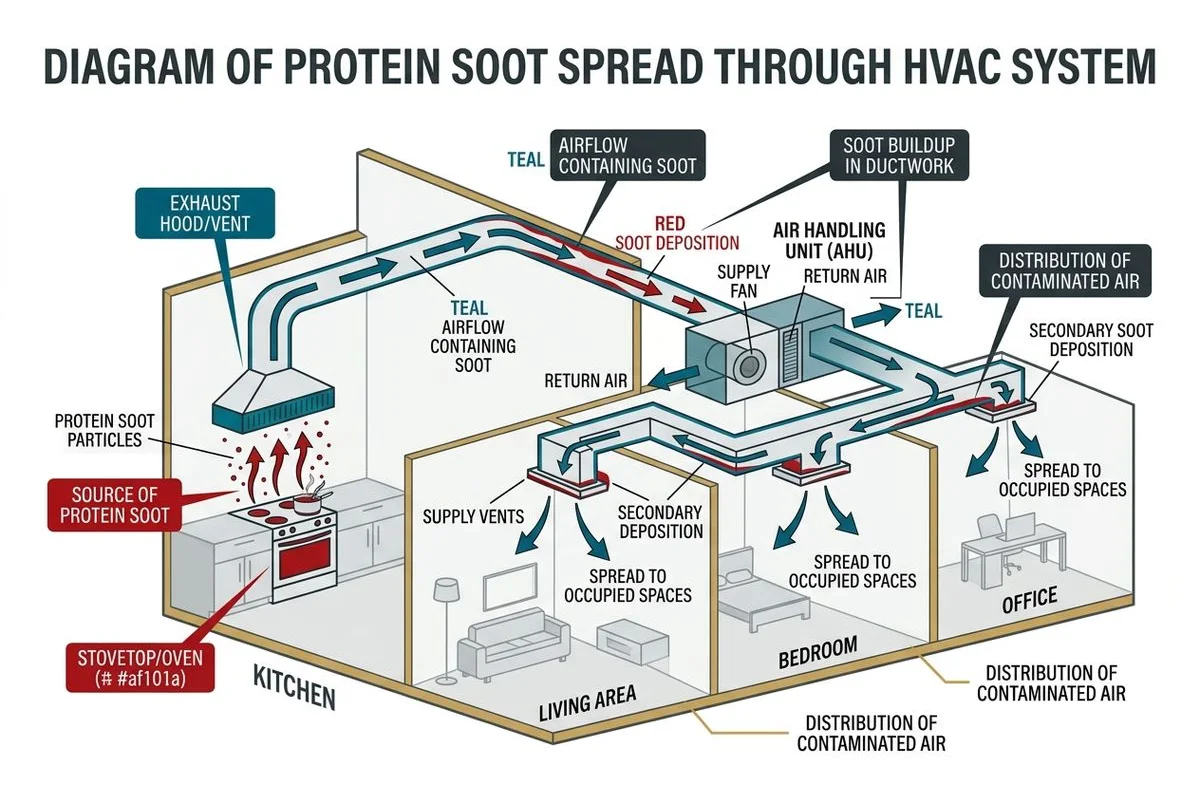
- The HVAC system hides the source: Even if you clean the countertops perfectly, the protein residue trapped inside the ductwork keeps releasing that pungent odor every time the air conditioner or heater runs.
The 48-Hour Window of Corrosion
Homeowners usually realize within a few days that the smell remains just as strong.
We often arrive to find the cleanup is now significantly harder.
The acidic nature of the soot oxidizes rapidly, entering a critical 48-hour window of corrosion.
Our teams know that once the oil smears into porous materials like drywall or unsealed wood, the chemical damage accelerates quickly.
Where protein soot spreads
The visible scorch zone from a frying pan fire rarely covers more than a few square feet.
We assess the actual contamination zone to be vastly larger, often covering adjacent rooms and the HVAC ductwork.
The intense heat forces the oily smoke to expand rapidly outward.
Our scope of work must account for the entire path of the airflow.
The contamination typically spreads across these specific areas:
- Throughout the primary kitchen zone: The grease coats every cabinet box, drawer interior, range hood, and the exterior of the refrigerator.
- Into adjacent living spaces: The microscopic particles drift into dining rooms and hallways wherever the air currents lead.
- Inside the HVAC ductwork: If the system fan was running, the soot immediately pulls into the return vents and coats the air handler.
- Deep into soft contents: Drapery, upholstery, and bedding absorb volatile organic compounds at a much higher rate than hard surfaces.
- Onto sensitive electronics: The oily film settles onto exposed circuit boards, which can cause severe corrosion if left untreated.
This extensive spread explains why a simple wipe-down is never enough.
We always mandate a whole-house assessment, full HVAC decontamination, and strict content triage instead of just focusing on the visible burn zone.
How professional protein soot kitchen fire cleaning works
Eliminating this stubborn residue requires chemistry, not just elbow grease.
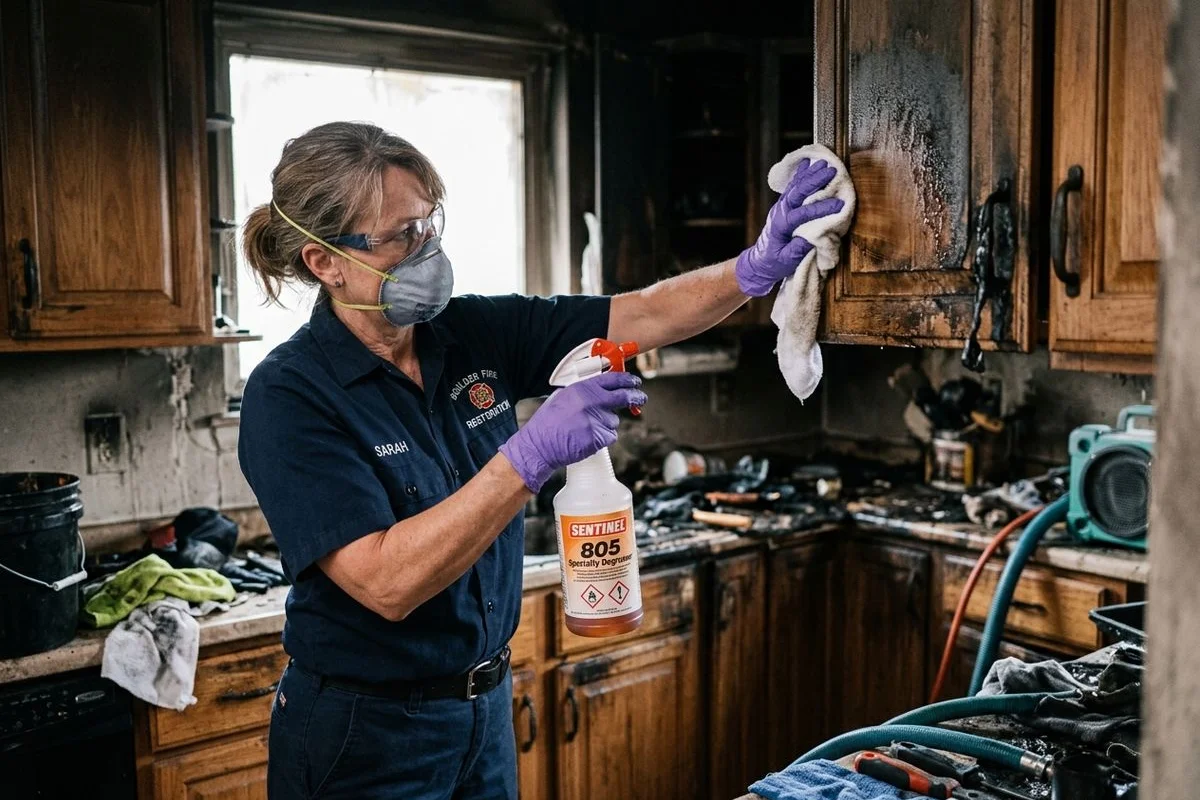
We utilize specialty industrial-grade alkaline degreasers, utilizing heavy-duty chemical formulas similar to those from brands like Algonquin or Momar, designed specifically for high-heat fire residues.
These high-pH formulas actively break down the heavy oils, greases, and resins that water cannot touch.
Our technicians apply these agents in a very specific sequence, completing multiple passes on every single surface.
This rigorous process treats cabinet faces, drawer interiors, raw wood cabinet boxes, and all adjacent surfaces.
Chemical Surface Neutralization
The physical cleaning phase happens in parallel with the HVAC ductwork decontamination.
We must remove the physical film from the environment before treating the air.
Leaving any sticky film behind means the smell will eventually return when the temperature or humidity changes in the home.
Advanced Odor Elimination Strategies
Once the surfaces are physically clean, the focus shifts to neutralizing the odors trapped inside porous materials.
We rely on a combination of thermal fogging and hydroxyl generators to destroy the remaining odor molecules.
Thermal fogging releases a heated deodorizer that mimics the exact behavior and penetration of the original smoke.
Our equipment then deploys hydroxyl radicals (OH), which are naturally occurring molecules that safely break down volatile organic compounds.
Comparing Odor Removal Technologies
Understanding the different deodorization tools highlights why professional methods succeed where store-bought sprays fail.
We select the specific technology based on the severity of the fire and the materials affected.
| Treatment Method | How It Works | Best Application |
|---|---|---|
| Store-Bought Sprays | Coats the air with synthetic perfumes to mask the existing smell temporarily. | Minor, everyday cooking odors; ineffective for fire damage. |
| Thermal Fogging | Vaporizes a deodorizing chemical to follow the exact path of the smoke. | Penetrating porous materials like wood, drywall, and textiles. |
| Hydroxyl Generators | Produces hydroxyl radicals to dismantle the molecular bonds of the odor. | Safe, continuous odor elimination in occupied homes over 48 to 72 hours. |
A full professional protein soot cleanup typically takes three to five days for a standard US kitchen.
We consistently see homes fully recover when the right chemical approach is applied immediately.
If you are dealing with the aftermath of a protein soot kitchen fire, prompt action is your best defense against permanent damage.
We strongly recommend bringing in certified experts to assess the spread before the oils embed into your drywall.
For the full kitchen fire restoration scope, see our dedicated service page.
Our team is ready to help you map out the exact steps for your property.
For a deeper look at different smoke residues, see our guide on types of soot and how each is cleaned. It also helps to understand the common causes of kitchen fires and how the resulting damage travels through the rest of the home.
Frequently asked questions
Why does my kitchen still smell after a small grease fire? +
Protein soot leaves an almost-invisible greasy film with intense, persistent odor. Ordinary cleaning misses it — sometimes makes it worse — and the smell stays for weeks or months without specialized degreasing.
Why can't I see protein soot from a grease fire? +
Unlike dry soot from a wood-fueled fire, protein soot is a thin greasy film rather than a powder. It's translucent and clings to surfaces in a way that's invisible until raking light catches it.
Does a small kitchen fire need professional cleanup? +
Almost always, yes. The visible burn is usually small; the protein soot spread is large. Without professional cleanup, the odor lingers for months and the cleaning becomes harder the longer it sits.
Need help with fire or smoke damage in Boulder?
24/7 emergency response with a 60-minute guarantee across Boulder County. Call our team — we'll secure your property and walk you through the next steps.